Movies On The QL

Some tentative first steps have been taken by users on QL Forum to implement animated graphics and even simple movies on faster QL-compatible platforms.

There have been some previous moves in this direction – software such as the Q-Top Animator by Urs König (available on his The Distribution and QL/E packages), and some “Tv Movies” on PD software disks – I think they were originally published via the Italian QL group Q-Italy.

QL Forum member Cristian started the discussion by providing a fairly simple routine to rapidly copy screen image files to the screen from ramdisc, taking advantage of the speed of LBYTES working with files from ramdisc, loading a numbered sequence of screens with suitable pauses in between, something like:

FOR n = 1 TO number_of_screens
LBYTES ram1_SCREEN’&n&”_scr”,131072
PAUSE speed%
END FOR n

Various suggestions were made, such as making use of the second screen space in memory on a Minerva-equipped system, so that frames could be loaded to either screen area and quickly ‘switched’ between the two screens.

The main limitation here was that it only displayed 512×256 (32 kilobyte) QL screens, and relied on the screen being at the same address in memory as on an original black box QL.

Per Witte took things a stage further by utilising Bob Spelten jr.’s SQRview program to convert screens to sprites, which can then be output to the screen using the SPRW command from Easyptr, which allows for a variety of frame sizes to be handled and a coordinate to be specified within a window.Per went on to produce a basic player, eventually called Qplayer.

David Westbury’s PHGTK (Photon General Toolkit) allows multi-frame animated GIF images for example to be output as individual PIC files, with the unused 10th byte in the file altered to specifiy a frame timing parameter, which opens up another avenue for animating using multiple PIC files, pasted to the screen in the right order with frame timing taken from each file to pause before the next file. Some PIC file window load/save functions such as David’s fun.zip http://www.qlforum.co.uk/download/file.php?id=942 could be used to display the individual frames.

The disadvantage of this approach is that PIC files are uncompressed, so anything other than the shortest of animations could produce massive output files. GD2 sprites do at least have the option to be compressed using a simple Run Length Encoding RLE) which does go some way towards reducing file sizes.

There was some discussion of combining the individual frames into a single large file so that an entire “movie” or animation could be made into a single file for convenience.

There was some discussion of exploring the use of compression utilities such as Zip or Bzip to reduce file sizes, but it was eventually determined that decompression could not take place fast enough to keep up with, say, a 10 frame per second video.

Marcel Kilgus joined the conversation and true to form he could not resist the temptation to write what he called a “quick and dirty” movie player including sound, which he made available to download at https://www.kilgus.net/2016/12/05/qmovie-smsqe-movie-player/ – this is 135MB in size and Marcel warned it may only work on QPC2.

The movie file itself is about 320MB in size and contains about 2 minutes of concert footage shot by Marcel himself.

The source files are included for those wishing to tinker with this. It is all supplied as a copy of QPC2 and SMSQE.BIN configured ready to go with no user intervention once unzipped to a folder on your Windows hard drive. Some of the files are in a qxl.win file, the others in the Windows folder accessed by DOS1. The movie file itself is accessed via DOS1_ – Marcel says that strange things happen when trying to move this sheer amount of data quickly via a WIN file.

He established that the player has to stream about 2.6MB per second in this case, meaning most systems could only handle this much data without compression – using BZIP2 or GZIP would result in too many decompression delays. Marcel ended up with a Qmovie file which is an interleaved data format with one second of audio, followed by one second of video in uncompressed format, with information such as resolution and frame rate hard coded into the qmovie_exe file.

QL On The Cover

It’s not every day that you see our favourite computer grace the covers of a non-QL magazine.

Phoebus Dokos

The magazine in this case is Retro Planet, a Greek retro computing magazine.

Featured on the outside of the December 2016 issue, the cover story is a detailed tribute to the Sinclair QL written by Phoebus Dokos (left), illustrated with some great photographs by Anthony Nicholas.


This is the 14th edition of Retro Planet

For further information, visit the magazine’s website at http://www.retroplanet.gr/

Mini QL Workshop

Today I took advantage of the opportunity to join some QL users from the north of England at a mini QL workshop organised by NEMQLUG and held in a Quanta committee member’s home. This was the first in a series of four such events planned in 2016. 9 of us came together for an afternoon of QLing. Read my report and details of when the next events will be held on my blog at https://dilwyn2.wordpress.com/ – the posting heading is ‘Mini Workshop’.

Dilwyn Jones

QL Tools for HxC

This is a version of qltools modified to operate directly on .hfe files as used by the HxC floppy emulator. It will need the libhxcfe.dll from the http://hxc2001.free.fr/floppy_drive_emulator/index.html  this is available by downloading and extracting the HxCFloppyEmulator software. (Graeme Gregory).

Related to the QL Tools for HxC is a DOS batch copy routine by Ian Johnston, to copy files to an SD card image using the Windows exe version of QLTools (command line) with the HxC floppy emulator, .HFE files. Hopefully of use to HxC users, as the QLTools currently has no facility to process batches of files.

The HxC is a floppy disk emulator system, based on an SD card system which plugs into a QL and pretends (as far as the QL is concerned) to be a floppy disk drive, bu the files are held in an image file on the SD card. A small screen on the HxC interface lets you choose which image to use. Rich Mellor has provided a simple guide to this device at http://www.dilwyn.me.uk/docs/manuals/index.html

Spy and MasterSpy Editors

Spy and Master Spy text editors from A.R.K. (Applied Research Kernel), formerly commercial programs, are now available for free download from Editors and Viewers page. Includes a manual for Master Spy, but manual for Spy to follow.

Thanks to various people, I have been able to preserve version 2.4 and 3.0 of Spy, and versions 1.3, 2.1 and 3.3 of MasterSpy. I’m very grateful to Richard Howe of A.R.K. for permission to make these and the manuals and Configuration Parameter Sheets available from http://www.dilwyn.me.uk/editview/index.html

QL Wreck Dive

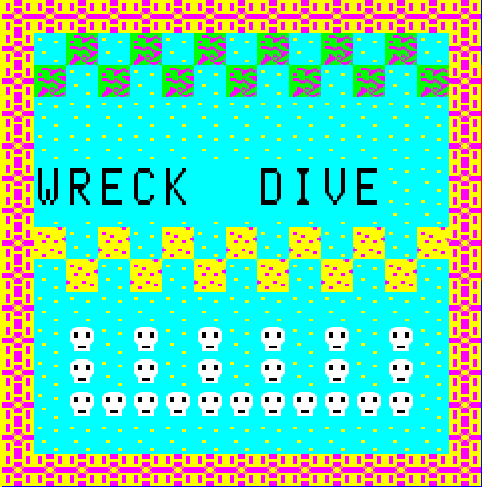
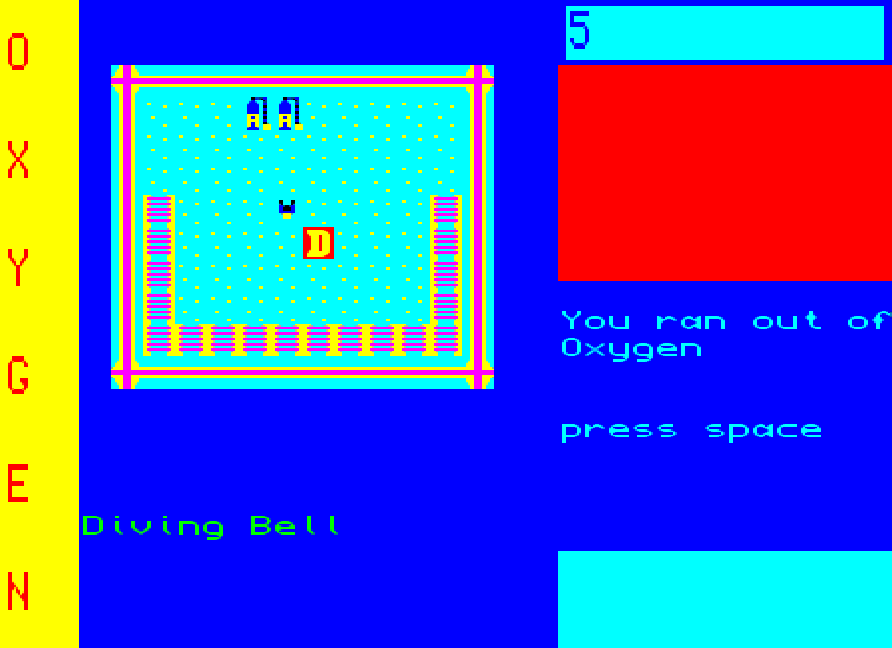
Rich Mellor has managed to make contact with former QL software author Nick Ward, who wrote some of the QL titles available from CGH Services and DJC. Nick has given permission for his QL software to be released as freeware, starting with v2.03 of Wreck Dive, featuring a diver exploring a shipwreck in search of treasure. 6 decks and 140 rooms to explore. Other titles may follow when we have been able to locate copies. Download the game from http://www.dilwyn.me.uk/games/index.html

Screen dump from Wreck Dive game for QL

Screen dump from Wreck Dive game for QL

Screen dump from Wreck Dive game for QL

Screen dump from Wreck Dive game for QL

Sandy Discount Codes For Quanta Members

Don’t forget if buying certain products from Dave Park at Sandy that you can still use the 25% off code QUANTABAT and QUANTAPAD on the Gold Card battery replacements and microdrive felt pads, and 10% off with QUANTAMIN codes if buying a Minerva MkII (either version) published in the News Supplement of the last issue. These special offer codes for members are valid throughout 2014.

Impact Entertainments QL Software

Rich Mellor writes:

Having tracked down Philip Jones who ran Impact Entertainments with his friend Andrew Cserbakoi, the following items of software have now been released as freeware:

  • Here We Go – a text adventure written in ACT
  • The Gee Gee System – a system to increase your chances when betting on horse races
  • Quizmaster – a Pub Quiz game

I updated Quizmaster to allow you to load in extra sets of questions – this was then sold as Quizmaster II.

I will also release Quizmaster II as freeware.

I can obviously send Quizmaster II including the sources to Dilwyn for the Sinclair QL Homepage.

Phil is going to have a look for copies of Here We Go and the original Quizmaster. Hopefully they also have a copy of the Gee Gee system (presuming any of these cartridges still load).

However, if anyone else has copies of these programs on disk – please send them to Dilwyn…

Here We Go! and Quizmaster II are now available to download from the Games page on my website at http://www.dilwyn.me.uk/games/index.html